AUTONOMOUS HAZARDOUS ENVIRONMENT SERVICES
Drone Hazardous Residue Removal
Drone hazardous residue removal gives industrial, defense, utility, and critical infrastructure operators a safer way to address contaminated or difficult-to-access surfaces. AERTEK combines advanced aerial robotics, controlled fluid delivery, and digital inspection technologies to reduce unnecessary personnel exposure while supporting precise and repeatable surface treatment.
REDUCING EXPOSURE AT THE SOURCE
A Safer Way to Remove Hazardous Residues
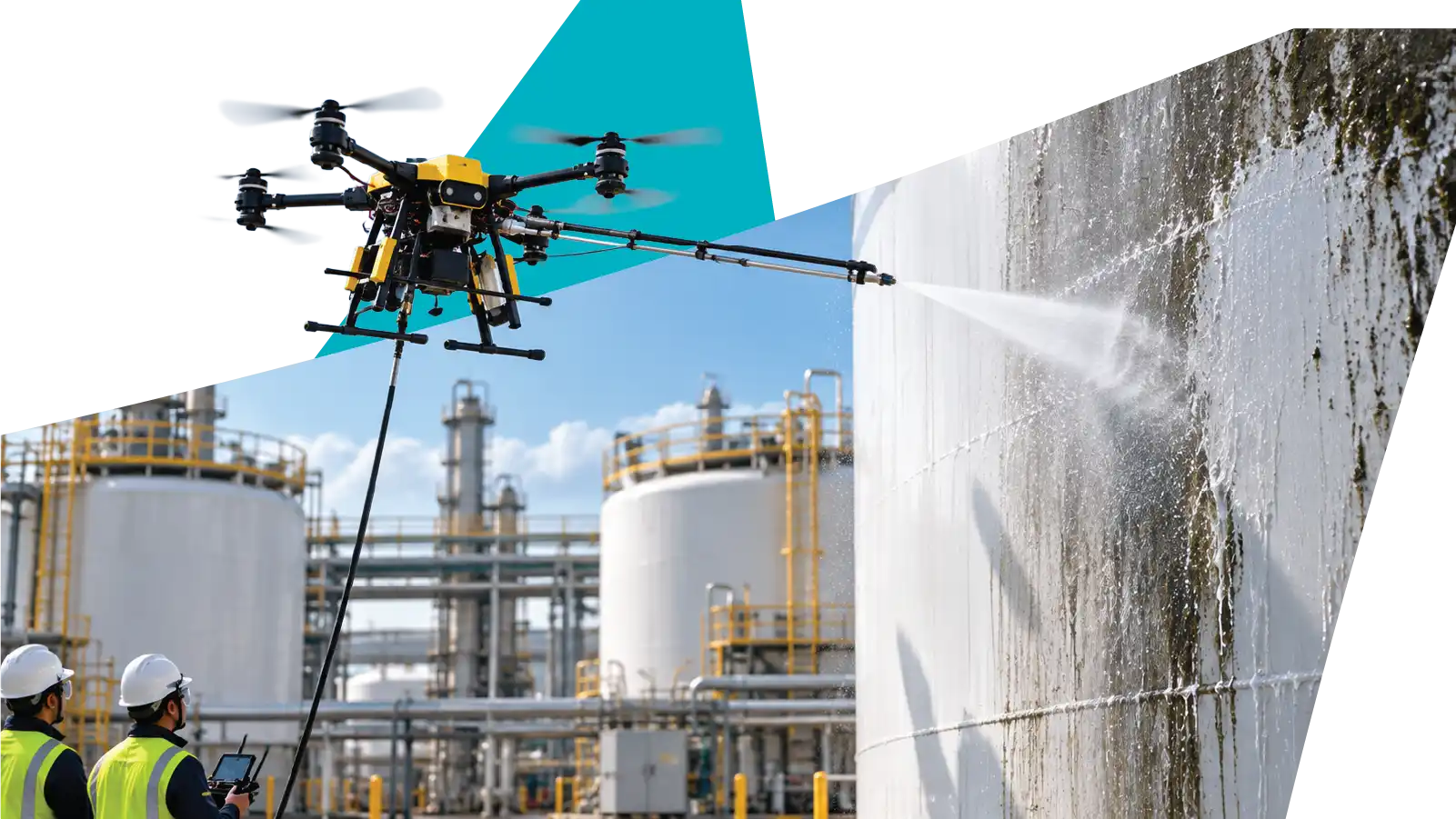
Hazardous residues can accumulate on industrial equipment, exterior structures, tanks, process facilities, infrastructure, and other large surfaces where traditional removal methods may require personnel to work at height or enter controlled areas.
Conventional operations can involve scaffolding, lifts, rope access, extended manual spraying, and direct proximity to contaminated surfaces.
AERTEK approaches the problem differently.
Our aerial robotic systems bring the treatment process to the surface while operators remain positioned at a safer distance whenever mission conditions allow. This can reduce unnecessary work at height, limit direct exposure, and improve access to areas that are difficult to reach using conventional methods.
The objective is not simply to clean a surface.
It is to create a safer, more controlled, and more intelligent residue-removal workflow.
TARGETED SURFACE TREATMENT
What Hazardous Residue Removal Can Address
AERTEK systems can be configured for site-specific surface cleaning and residue-removal applications following an assessment of the contaminant, substrate, cleaning chemistry, environmental controls, and operating conditions.
Soot & Combustion Residue
Process Buildup
Contaminated Exterior Infrastructure
Industrial Chemical Residues
Corrosive Deposits
Post-Incident Surface Residue
Treatment methods are determined on a project-specific basis. Residue characteristics, substrate compatibility, cleaning chemistry, containment requirements, runoff management, and applicable regulations must be evaluated before deployment.
drone hazardous residue
Frequently Asked Questions
What is drone hazardous residue removal?
Drone hazardous residue removal uses aerial robotic systems to deliver water, approved cleaning solutions, or other treatment media to contaminated or residue-covered surfaces. The objective is to perform selected surface-treatment operations while reducing the need for personnel to work directly at the target location.
Is hazardous residue removal the same as decontamination?
Not necessarily. Residue removal generally focuses on physically removing deposits or contaminants from a surface. Decontamination can involve specialized processes designed to remove, reduce, or neutralize specific contaminants. AERTEK determines the appropriate approach based on the mission and material involved.
Can drones remove chemical residues?
Certain chemical residues may be suitable for drone-assisted removal when the contaminant, surface, treatment chemistry, environmental conditions, and containment procedures have been properly evaluated. Each application requires technical review before deployment.
What types of surfaces can be treated?
Applications may include compatible industrial walls, tanks, large structural surfaces, infrastructure, equipment exteriors, building envelopes, and other assets. Surface compatibility is evaluated before treatment.
Can AERTEK use specialized cleaning chemicals?
Depending on the mission and equipment configuration, approved cleaning or treatment solutions may be incorporated into the process. Chemical selection must be compatible with the aerial system, substrate, residue, environmental requirements, and site procedures.
Can the system operate around active industrial facilities?
Potentially. Operations depend on site conditions, airspace, personnel activity, obstacles, facility restrictions, weather, and other safety considerations. AERTEK evaluates these conditions as part of mission planning.
Can inspection be performed before or after treatment?
Ready to Protect Your Critical Infrastructure?
Partner with AERTEK for autonomous exterior cleaning, infrastructure washdowns, specialized decontamination, facility maintenance, and digital reporting designed to improve safety, efficiency, and operational readiness.